Showing posts with label Maths. Show all posts

Wednesday, 14 May 2025

Inquiry update - Developing Number Sense through Talk

This year, my inquiry focus question is:
How can I efficiently and effectively help my students learn the multiplication basic facts?

One strategy I’ve been using to develop my students’ number sense is Number Talk. Number Talk is a short, daily routine where students solve math problems mentally and then share and discuss the strategies they use. It focuses on building number sense, flexibility with numbers, and clear mathematical thinking. Below are 2 examples of the problems used for Number Talks.



So far, this approach seems to be going well. The children are enjoying it, and even our reluctant mathematicians are engaging in the activity. make point of saying at the start of each Number Talk that it’s good to struggle, it’s good to get things wrong, and we celebrate mistakes. My hope is that by doing this regularly, my students will become more confident in sharing their thinking and that it will help reduce their math anxiety.

At the end of Term 1, recorded myself leading Number Talk lesson and uploaded the video to Vosaican AI video analysis tool that provides unbiased feedback based on given prompt. Below is the feedback I receivedIt was reassuring to see that I’m on the right track in developing my students’ number sense.


AI prompt: How effectively did the teacher create opportunities for the children to develop their number sense?

Opportunities for Developing Number Sense

The teacher effectively created opportunities for the children to develop their number sense through several strategies during the number talk session. Here are some key points that illustrate this:

• Encouragement of Mistakes: The teacher emphasized that making mistakes is a part of learning, stating, "It si good ot make mistakes... we only learn by making mistakes" (00:55). This approach helps reduce math anxiety and encourages students to engage with challenging problems.

• Individual Thinking Time: The teacher provided students with 2 minutes to work on a problem independently before discussing ti with peers (02:04). This time allows students ot formulate their own strategies and develop confidence in their mathematical thinking.

• Peer Collaboration: After individual work, students were instructed to share their strategies in groups, promoting collaborative learning. The teacher stated, "If you didn't solve ,ti your job is to

listen and learn from your peers" (04:40). This encourages students to articulate their thought processes and learn from one another.

• Focus on Explanation: The teacher encouraged students to explain their reasoning by using the word "because" when sharing their answers (01:30). This practice fosters deeper understanding and helps students articulate their mathematical thinking.

• Discussion of Different Strategies: The teacher facilitated a discussion where students shared different methods for solving the problem, highlighting both similarities and differences ni their

approaches (12:02). This not only validates various strategies but also reinforces the concept of

place value partitioning, which is crucial for number sense.

• Reflection on Strategies: The teacher prompted students to reflect on their strategies and

understand the reasoning behind them, stating, "Your job si to try and understand their thinking" ( 09:16 ). This reflection helps solidify their understanding of mathematical concepts.

Overall, the teacher's methods foster a supportive environment that encourages exploration, discussion, and reflection, al of which are essential for developing number sense in students.

Research:

Research indicates that collaborative learning and peer discussions can significantly enhance students' understanding of mathematical concepts (Cohen, 1994). Additionally, allowing students to make mistakes

and learn from them is crucial for developing a growth mindset, which is linked to improved mathematical performance (Dweck, 2006).


Wednesday, 12 March 2025

Teaching Inquiry 2025

Inquiry Focus Question

This year my inquiry focus question is: How can I efficiently and effectively help my students learn the multiplication basic facts?

This inquiry has arisen from yet again having a class of Year 7 & 8 students who struggle with their times tables. Only 27 out of 29 students can recall the 1-12 times tables effectively. This gap in knowledge is a significant barrier to their mathematical progress. Multiplication is a foundational skill that underpins division, fractions, algebra, and problem-solving. Without instant recall and a deep understanding of multiplication, students find it difficult to engage with more complex mathematical concepts, leading to frustration and disengagement.

Mastery of multiplication facts is not just about rote memorisation; it provides students with the confidence and efficiency needed to tackle higher-level math. Research indicates that fluency in basic facts reduces cognitive load, allowing students to focus on problem-solving rather than simple calculations. A lack of automaticity in multiplication can slow students down and impact their overall mathematical achievement.

Initial Observations and Challenges

  • Inconsistent Recall: While some students can recall multiplication facts effortlessly, others rely on inefficient strategies such as skip counting or using their fingers, which slows them down.
  • Low Engagement: Traditional methods like timed tests and rote memorisation worksheets often fail to engage students, leading to boredom and resistance.
  • Confidence Issues: Students who struggle with multiplication facts often develop math anxiety, leading to avoidance behaviours in math lessons.
  • Lack of Transfer: Even when students demonstrate knowledge of times tables in isolation, they struggle to apply them in problem-solving or fraction work.

Potential Strategies to Explore

To address these challenges, I plan to trial a range of strategies and interventions to help students develop both fluency and conceptual understanding.

1. Developing Number Sense
Building a strong number sense is crucial for students to understand multiplication conceptually, rather than just memorising facts. Activities that encourage flexible thinking, such as,  exploring different strategies to solve a problem, using arrays and area models, or discussing patterns in multiplication can help students make deeper connections. Encouraging children to explain their reasoning and explore multiple approaches will strengthen their overall mathematical thinking.

2. Maths Games and Digital Tools

Utilising technology and games can make learning multiplication facts more engaging. Platforms such as Maths fact Lab,  Amplify Fluency, or Kahoot offer competitive and fun ways for students to practice in a low-pressure environment. Moreover, using math games such as Spiral and How Close to 100 will be a fun and engaging way children can develop their multiplication knowledge.

3. Daily Fluency Routines

Implementing short, daily fluency activities such as number talks, quick recall drills, and partner challenges can help reinforce multiplication facts. These will be brief (5-10 minutes) but consistent to hopefully build automaticity over time.

4. Peer Teaching and Collaboration

Encouraging students who have strong multiplication skills to support their peers can be a powerful tool. This could be through paired practice and games.

4. Real-World Applications

To help students see the relevance of multiplication, I will incorporate problem-solving tasks related to real-life scenarios, such as budgeting, cooking, and sports statistics. Applying multiplication in meaningful contexts can increase motivation and understanding.

Measuring Success

To assess the effectiveness of these interventions, I will track student progress through:

  • Pre- and Post-Assessments: Measuring improvements in recall speed and accuracy.
  • Student Reflections and Surveys: Gathering student feedback on their confidence and engagement.
  • Observation and Anecdotal Notes: Monitoring how students apply multiplication in various math contexts.

Looking Ahead

This inquiry is an evolving process. As I trial different strategies, I will reflect on what works best and adjust my approach accordingly. My goal is to create a learning environment where all students feel confident in their multiplication skills and can use them as a strong foundation for further mathematical success.

If you have any insights, resources, or strategies that have worked in your classroom, I’d love to hear them!

Thursday, 8 August 2024

Manaiakalani Maths practise Intensive - Day 4

Today we spent the day exploring number - Place Value, Fractions, Decimals, Percentages and Integers. Below are some of my takeaways. 

Materials/Manipulatives

I was reminded again how important it is to use materials to introduce new maths concepts, to further student's understanding and to correct misconceptions. In the coming weeks I'm looking forward to using deci-pipes and deci-mats to teach decimals. 


Vocabulary
I was also reminded how important maths vocabulary is in students mathematical understanding. I have come away thinking about how I can be more intentional and explicit about tending to this vocabulary. I have been guilty of focussing so much on teaching a new mathematical concept that I can brush over the vocabulary instead of taking the time to tend to it. 


Choral Counting
Choral counting is an activity in which the teacher leads children in counting aloud together by a given number. Today was the first time I was introduced to it. I can see how beneficial it could be for developing student's number sense and computational skills. I'm interested in using it particularly with decimals numbers for my year 7/8 students. 


Thursday, 27 June 2024

Manaiakalani Maths practise Intensive - Day 3


Today was the third day of the Manaiakalani Maths Practice Intensive (MPI), focusing on planning an effective math program. Here are some reflections on the content I found particularly interesting.

Weekly Timetable

I was particularly interested in the discussion about structuring a weekly timetable for a class. In the past, I have used a tumble/rotation system, but it has always been challenging for students to complete their tasks or follow-up activities due to insufficient time.

Georgie introduced a new approach today: a tumble system where, aside from the time spent with the teacher, students have the freedom to choose what they do during the other slots. This method fosters student agency and allows them to take control of their learning.

I am eager to explore this approach. While I anticipate it will require significant scaffolding initially, I believe it will be beneficial in the long run.

Tracking my kid's progress

Another area I’m interested in improving is tracking my students' progress against the curriculum. Although I have the maths progressions as a starting point, I would like a spreadsheet with a more granular breakdown of achievement progression, such as knows times tables from 1-10. This detailed tracking would be extremely helpful in monitoring progress. I am hopeful that once the new curriculum is finalised, such detailed progressions will be included.


Independent activities

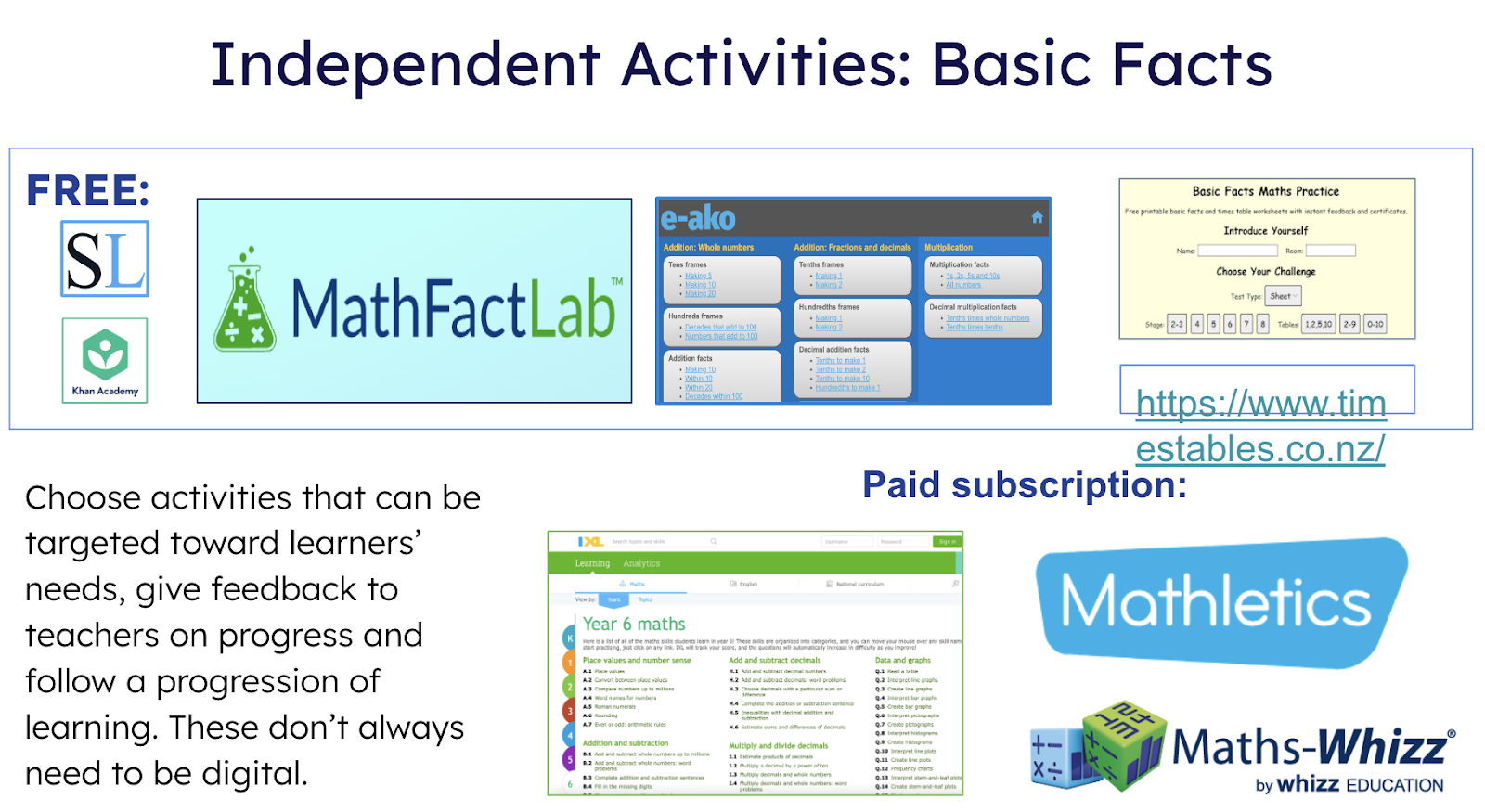
We had an opportunity to explore independent learning activities for children to do when they are not with me. I'm looking forward to trying out some of the activities listed below. My hope is to find something fresh and engaging that will be beneficial for my kids. While I already use independent activities, they could use some refreshing. The challenge I see is finding the time to track my children's progress on these independent activities.


Thursday, 6 June 2024

Manaiakalani Maths practise Intensive - Day 2

Teacher Workbook

Day 2 of the MPI brought a great bunch of things to think about and work on. I was particularly interested in the Teacher workbook that was highlighted. Essentially this is a one-stop shop spreadsheet that contains all the information you would need to plan and track your teaching and leanring. Some of the big pieces included:

  • Student assessment data
  • Responses to student maths profile survey
  • Long Term Planning Coverage
  • Weekly planning sheet
  • Curriculum leanring intentions for the various year groups


When I initially saw the workbook it was easy to get overwhelmed by all the tabs and the amount of possible information it could hold. However, I can see how it could be very useful in planning and tracking leanring and I'm looking forward to putting it to use. I like the idea of having everything in one place to plan and track for leanring rather than multiple spreadsheets, documents and sites etc.


Student Task board

I was also interested in the suggested student tasks boards. Like the planning doc, it was initially quite overwhelming with a load of content but I can see how if it was dialled back a bit it could be very helpful for our learners. I'm particularly interested in including more student choice into my practise.


Wednesday, 5 June 2024

Maths Student Survey Responses

I recently gave my maths class a survey about how they view themselves as mathematicians. The results were interesting. Below I have shared some reflections from the data. There was a total of 28 responses from individual students.


How do you feel about maths?

1) I hate maths  -  4) I love maths 


43% either hated or disliked maths. I would like to dig deeper and find out why these children feel this way. My hope is that by the end of the year we will have a more positive result to this question.


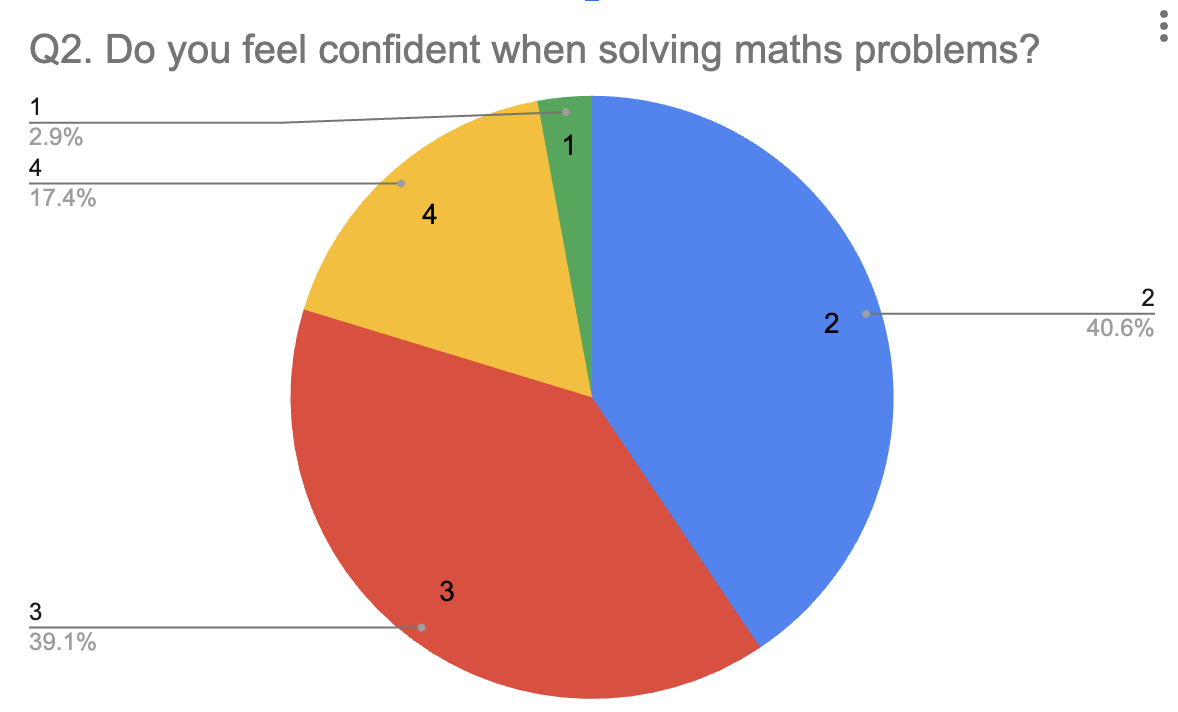
Do you feel confident when solving maths problems?

1) I'm not confident at all  -  4) I feel very confident


Does your teacher think you are good at maths?

1) No the think I struggle  -  4) Yes they think I'm really good 

I was initially surprised by this response because I thought more of them would have picked 3 or 4. Upon reflection I wonder if a better question could have been 'Does your teacher believe you are capable of achieving in maths'. The reality is, some children do struggle with maths, they know it and the teacher knows it. It would be ignorant for a teacher to believe a child is good at maths when clearly they struggle however hopefully teachers are believing their children are capable of achieving despite them struggling.


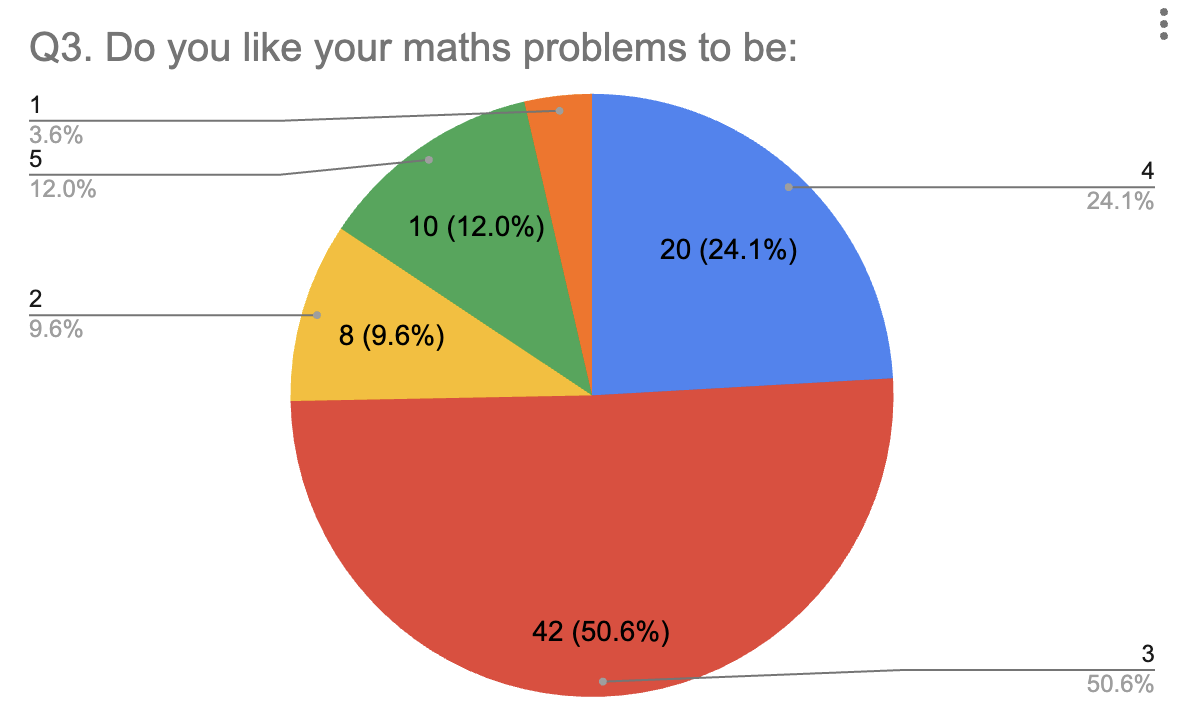
Do you like your maths problems to be:

1) Easy -   5)Hard

I found it interesting and reassuring that 36% wanted reasonably hard or hard problems. I assumed it would have been less. I suspect the 50% that selected 3 want problems that aren't to hard or too easy but somewhere in the middle like the Goldilocks Zone.


Overall, these survey results gave me some great things to think about. They have actually given me more questions than answers however that is a good thing and I'm looking forward to finding out more. 


Thursday, 16 May 2024

Manaiakalani Maths practise Intensive - Day 1

Today was the first day of the Manaiakalani Maths practise Intensive (MPI), a 9 day maths development course aimed at equipping teachers with the necessary skills and knowledge to teach maths effectively. 

For part of the day we reflected on the Pillars of Mathematics Practise. We asked ourselves what elements are we doing well in and what elements need attention. I found this a productive and worthwhile exercise. In the business of teaching you often don't have the time to do this, or if you do it gets taken up with something more pressing.


From this reflection I came away wanting to focus on developing extended mathematics discussion in my practise. Years back I did a lot of this, particularly when our school was adopting the Developing Mathematical Inquiry Communities (DMIC) pedagogy. However, in recent years I haven't been using discussion based leanring in maths. I look forward to teaching my students about the Ground Rules for Talk and developing their ability to robustly discuss maths problems and to share and justify their thinking.  


I was also interested in how I could integrate other curriculum areas into maths. Because I see another group of students for literacy I have often shied away from integration in maths however, I see the benefits am looking forward to embracing the integration challenge. Stay tuned for more updates.


Thursday, 15 November 2018

Inquiry 2018 Summary


Inquiry Focus
This year I have been inquiry has been based around developing the mathematical dialogic discourse ability of my children. In particular my focus has been on developing their ability to explain and justify their mathematical thinking as this was an area of weakness for my children.

Target Children
My Target group were made up of 3 boys and 3 girls of varying mathematical ability. They were selected because they all struggled to express and justify their mathematical thinking.

What happened for my children?
 - More confidence to share
Every child became more confident to share their thinking in class. Anecdotally this is what I was seeing in class as the year progressed. Children who once shied away from sharing were now sharing and children were becoming more confident to speak up when they didn't understand something and question it. This Anecdotal information was verified with the data collected from a student voice survey.


 - Increase in ability to explain and justify their thinking
My target kids had a small increase in their ability to explain and justify their mathematical thinking. As mentioned in previous posts this has been an area of frustration for me as I have not been seeing the gains I thought I was going to see.  Below shows the data of my target children taken from the measuring tool I designed to capture their ability to explain and justify. It needs to be pointed out that this data was taken when children were working independently on their maths problem these responses were unsolicited. This was not a teacher facilitated discussion.


 - April

  - June

  - August

 - November


The greatest improvement has been in the children's use of the word 'because'. In the last few months we have really been focussing on using 'because' to justify our explanations. My kids would often explain what they did but would not justify it. This data matches with what I'm seeing with the rest of my class too. It has been slow going and we have a way to go but we're getting there. 

Anecdotally the children are talking more and developing the ability to discuss and justify their thinking. Children who were once not engaged are now showing engagement and children who once would not participate in discussions are which is encouraging.

Has this had an impact on their maths achievement?
The jury is still out on this. The Maths PAT data below shows minimal increase in their achievement however these results have been effected by our schools' teachers and children learning and adjusting to DMIC maths. 5/6 of the target children made progress. Their progress average was 4.3 scale points. According to NZCER the national progress average for year 7-8 is 5.4 scale points. The average for the whole class that made progress was 5.1.

 - PAT data


What did I do to make this happen?

 - Waka paddle prompts
There was deliberate teaching on the type of things one would say if they were effectively explaining and justifying their mathematical thinking. These phrases and words were made into little waka paddles. The children would hold a bundle in their hand and the key was to use them in a maths session. Once you had used a prompt you would discard it. the idea was to get rid of all the waka paddles from your hand. This was used as a way of introducing the phrases and vocabulary into to the children and reminding them to use it.


 - Insisting on a response
In our maths sessions opting out was not an option. If I child was called upon they had to give some sort of response. "I don't know" was not an option. If they didn't have a response they had to say "Can you ask someone else please?". At that point I would ask someone else but then come back to them.

 - No hands up
Hands up was banned in our maths sessions. The children soon learnt that anyone could be called on to share their thinking which encouraged them to participate in the problem solving. They couldn't really on the usual eager beavers. At times the eager beavers found this frustrating as they really wanted to be the one to share but as time went on they adapted to the new system and no no hands up is the norm.

 - Discussion based games and activities
I used games to help get the children used to using the discussion vocabulary. For example to help ingrain the word 'because' in the children justifications they had to each say the following.

"I'm going to a dessert island and I'm taking _____________ BECAUSE _____________."

The focus of this was on the because. Starting a maths session with this simple game helped the children explain and justify more effectively when it came to their maths.

Next steps
As mentioned before this inquiry has been pretty slow going and I haven't seen the maths achievement I had hoped to see. I'm interested to see if next year the maths achievement will come now that the children have had a year learning how to effectively engage in dialogic discourse. My hope is that with this embedded in the children they will be able to focus mainly on maths in their maths sessions not on developing their dialogic discourse ability.

Thursday, 18 October 2018

Using 'because'

PROBLEM: My kids struggle to explain and justify their thinking and reasoning in maths.
WONDERING: How can I develop the mathematical dialogic discourse ability of my children?

As mentioned in a prior post I'm not seeing the progress I was expecting to see at this stage of the year.  Discussing my frustrations with Dr Aaron Wilson he assured me that inquiries which involve a culture and behavioural change are often slow going and can take a long time to see change. So that was reassuring.

The main frustration I have is that my kids struggle to use vocabulary that effectively explains and justifies their thinking. They will to some degree explain and justify their thinking using their own vocabulary however, the person trying to understand their thinking is often having to infer meaning and join the dots.

Among other unused vocabulary and phrases the most common unused word in helping to explain and justify is the word 'because'. Despite having introduced it earlier this year as part of the waka paddle prompts and insisting the children use it while explaining their maths problems the word 'because' is not yet common place in the classroom.

To combat this I'm going to introduce some activities/games where the kids have to use the word 'because' in order to successfully participate/complete the activity. My hope is that by using the word more frequently and highlighting it in a fun way prior to a maths session the children will transfer the use of 'because' to their mathematical explanations and justifications. I'll keep you updated.

Tuesday, 25 September 2018

Patience Young Grasshopper

PROBLEM: My kids struggle to explain and justify their thinking and reasoning in maths.

WONDERING: How can I develop the mathematical dialogic discourse ability of my children?

I recently presented my inquiry to a group of people at the Manaiakalani hui. While presenting I was asked what have I learnt about myself throughout this process. My response was that I didn't have as much patience as I thought. It is taking much longer than I would like to see a change in my kids which is really frustrating. At times I see glimpses of significant shift in their ability to explain their mathematical thinking then at other it times it's like it's week one, term one all over again.  I'm assuming that this is par of the course however it's still frustrating. I long for the day when those glimpses of effectively explaining and justifying are no longer glimpses but the new norm.

So where to from here? My advice form others has been to keep persevering and keep doing what you know works. The latter part is a good reminder as it's easy in the moment when it's not going well, when I'm feeling frustrated/tired etc to put aside the things you know work. For example using the waka paddle discussion prompts or requiring the kids to speak in full sentences and use the word because in their explanations. So,  I'm going to keep implementing that things that work, persevere, keep the long game in mind and get back on the horse.

Tuesday, 7 August 2018

Data, Reflection & Next Steps

PROBLEM: My kids struggle to explain and justify their thinking and reasoning in maths.
WONDERING: How can I develop the mathematical dialogic discourse ability of my children?

Below is the current data taken from a recoded maths session of my target group.


It's great to see the children explaining their thinking more freely however unfortunately they're not using the word 'because' often enough. They say things like "so you go 20.3 x 2 which is ...." but they don't explain why they multiplied 20.3 by 2 therefore, not justifying their thinking. It is also evident that the children are not asking questions of each other off their own bat.


So what can do or change to further develop their dialogic discourse? Although I've introduced the waka paddle prompts, had the children participate in talking activities and modelled dialogic discourse I'm not seeing the results I thought I'd see. This has me wondering do I just need to be more patient or do I have to try something different? Maybe it's a bit of both.

Recently, on my blog, I was challenged by Dr Jannie van Hees to look at incorporating real world maths into my class, to get my kids out of the class to explore the maths around our local environment. She suggested that using "... relevant, motivating, authentic contexts will generate much talk and figuring out....and when suggestions are shared, and justifications expected, rich maths and maths language dialogue will occur." This makes sense to me I guess the challenge lies in incorporating it in my DMIC lessons but I'm sure it can be overcome.


Thursday, 26 July 2018

Going into Term 3 Reflection

As term 3 kicks off I've been reflecting on my inquiry this for this year. In this reflecting I was reminded of the inquiry that I did last year. I found that I have been so focussed on my inquiry this year that I have forgotten about the things I discovered the previous year.

Things like:
- How effective materials are for learning new mathematical concepts and knowledge.
- How hands on follow up activities are effective in concretising new learning.
- How combining create to learn tasks with hands on follow up activities and materials is effective in    consolidating new mathematical concepts.

Problem
How do I keep inquiring into this years inquiry while still applying the things I learnt last year? The simple answer is to 'just do it' however when you're engaging in a whole new maths pedagogy (DMIC) this is easier said than done.

Possible solution
DMIC maths sees myself working with half the class while the other half works on independent activities. My plan is to incorporate my learning from last year into the activities the children are doing when they are not with me. I haven't quite worked out what this will specifically look like however I'm determined to put something into place so that my learning from last year doesn't go to waste.


Sunday, 1 July 2018

Quick Inquiry Update

PROBLEM: My kids struggle to explain and justify their thinking and reasoning in maths.

WONDERING: How can I develop the mathematical dialogic discourse ability of my children?

Anecdotally my target group are making progress in their ability to explain and justify their mathematical thinking. They are speaking with greater confidence and are using the word 'because' more frequently. They still often need teacher prompts but I'm finding they don't need as many teacher prompts and are more willing to share their thinking.

The waka prompts have been helpful in giving the kids something to launch from and they they are using them more frequently without me reminding them to use them. Unfortunately the kids still like to play with them and they can be a distraction but they are more useful than not. It has been great to see some of the kids request to not have waka prompts as they are confident they don't need them.

This week I will again be recording and measuring the mathematics discourse of my kids. I just hope the data reflects my anecdotal notes.

Thursday, 31 May 2018

First run with the waka paddles

PROBLEM: My kids struggle to explain and justify their thinking and reasoning in maths.

WONDERING: How can I develop the mathematical dialogic discourse ability of my children?

This week I used the waka paddle prompts for the first time. As they were a novelty the kids were eager to use them. At first they weren't using them meaningfully. They viewed it more like a game to get rid of their waka paddles. After some more discussion around the purpose of the paddles and how the prompts needed to be used appropriately and meaningfully the paddles started to be used more effectively. One annoyance is that some kids were more focussed on playing with the paddles than the maths task however, I'm hoping that once the novelty wears off this won't be much of an issue.

Monday, 28 May 2018

Waka paddle prompts

PROBLEM: My kids struggle to explain and justify their thinking and reasoning in maths.

WONDERING: How can I develop the mathematical dialogic discourse ability of my children?

The data I collected confirmed my suspicions that my kids struggled to explain and justify their reasoning in maths. My hunch is that the kids don't know how to do this effectively. To help them learn I have made prompts of the kind of things they should be saying when explaining and justifying their thinking.


The idea is that each kid holds a few prompts in their hands and their goal is to meaningfully use the prompt in their maths session. Once they have used it they can discard the prompt. My hope is that over time using these prompts will become second nature and they will no longer need them. I used the symbol of the waka paddle as we often talk about how we are one whanau and we are all in one waka. We need to all paddle in the same direction if we are to get anywhere. 

Wednesday, 9 May 2018

Some Baseline Data

PROBLEM: My kids struggle to explain and justify their thinking and reasoning in maths.

WONDERING: How can I develop the mathematical dialogic discourse ability of my children?

This week I recorded my target kids collectively solving a problem. My goal was to capture and measure their ability to explain their thinking and inquire about other's. I noted done each time each child used any of the phrases, or similar phrases below. The kids worked on the problem for 15 minutes and this is their results.It's worth noting that two of the target group were not there that day. Their row has been marked with a -. 


It's interesting to see that the children did try to express what they are thinking however it often wasn't backed up with a reason. The word 'because' was seldom used and the others were left to infer the mathematica thinking and process from what was said e.g "You add 20 to 100 and then you....". Equally interesting is that only one child asked for further information/explanation from others as they expressed their thinking.

This married up with what I have been seeing anecdotally so it's nice to have some actual data. We clearly have a long way to go in developing a community where kids can confidently express their thinking and inquire of others. My next steps involve explicitly teaching the kids how to express and justify their mathematical thinking. My kids need to view each other as both a learner and teacher. They need to connect with the idea that they can learn from their peers and that what their peers have to say is valuable.


Tuesday, 1 May 2018

Inquiry update: Let the recording begin!

PROBLEM: My kids struggle to explain and justify their thinking and reasoning in maths.

WONDERING: How can I develop the mathematical dialogic discourse ability of my children?

While I had every intention last term of recording my students in order to measure their mathematical dialogic discourse ability, due to the business of school life and external factors (a baby being born 5 weeks earlier than expected) this did not happen. 

However it's now week one of term two and I will be recording this week! It's going to be great to have some baseline data on my kids, a reference point to build from. I only wish I had done this earlier as anecdoatally I have already seen my target kids become more confident in their ability to engage in mathematical dialogic discourse. 

Wednesday, 11 April 2018

Measuring my kid's dialogic discourse ability

PROBLEM: My kids struggle to explain and justify their thinking and reasoning in maths.

WONDERING: How can I develop the mathematical dialogic discourse ability of my children?

As mentioned in a prior post,  to measure the dialogic discourse of the ability of my kids I will be recording my target group during their maths lesson and I'll be noting down each time a child uses specific justifying and explaining language and each time they inquire about others people thinking. Below is a list of questions and statements I will be listening out for. If you think I have left something out I'd be keen to hear from you.


Wednesday, 28 March 2018

Measuring and Tracking Progress

PROBLEM: My kids struggle to explain and justify their thinking and reasoning in maths.

WONDERING: How can I develop the mathematical dialogic discourse ability of my children?

One issue I had was working out how to measure the mathematical dialogic discourse ability of my kids. Anecdotally I could see that they struggle to explain and justify their thinking but how was I going to get quantifiable data. I discussed my problem with Dr Rebecca Jesson and we came up with (well she came up with) this solution.

I will record my target group during a maths lesson then I'll listen back and note down every time a child uses specific (which is yet to be decided) justifying and explaining language and each time they refer to the context of the maths problem when explaining their thinking.  I will also be noting down how often they need teacher prompts to draw out an explanation. By doing this regularly I should be able track and measure the kids mathematical dialogic discourse ability.

Wednesday, 14 March 2018

Target group PAT data

PROBLEM: My kids struggle to explain and justify their thinking and reasoning in maths.

WONDERING: How can I develop the mathematical dialogic discourse ability of my children?

As mentioned in my previous post my target group is made up of 3 boys and 3 girls. Below is a table of their Term 1 PAT maths data. While my focus is to develop the dialogic discourse ability of my children I hypothesise that if this happens then their mathematical knowledge and ability will also increase making them more proficient mathematicians.


The target group were selected because they struggle to vocalise what they are thinking. It's interesting to see that the struggle to explain and justify your thinking and engage in dialogic discourse is evident across the varying academic levels.


Teaching Inquiry Update

At the midpoint of my inquiry, I have started to see positive shifts in how students communicate their thinking during learning tasks. My i...