Thursday, 21 May 2026

Teaching Inquiry Update

At the midpoint of my inquiry, I have started to see positive shifts in how students communicate their thinking during learning tasks.

My inquiry question is:

How can I make student thinking more visible in learning tasks so I can make accurate assessment judgments, particularly for extension students?

After discussions with Danni Stone, I introduced and explicitly taught the R.A.C.E strategy within classroom tasks. Over time, students have begun using this framework with increasing confidence, and I am seeing stronger written explanations and clearer evidence of reasoning in their work.

This has already helped me feel more confident when making assessment judgments, as students are providing more visible evidence of what they know and understand.

However, as this inquiry has developed, a new challenge has become increasingly noticeable. While students are becoming more capable of explaining their thinking, some learners still approach tasks with a “can’t be bothered” attitude and are reluctant to put effort into fully demonstrating their understanding.

This has shifted part of my focus towards student engagement and self-efficacy. I am beginning to recognise that students not only need the tools and frameworks to explain their thinking, but also the motivation and ownership to care about showing their best learning.

Moving forward, I would like to explore strategies that help students:

  • Take greater pride in their work
  • Value effort and improvement
  • Build confidence in themselves as learners
  • Become more invested in demonstrating their thinking

While my original inquiry centred around assessment evidence, it is becoming clear that student mindset and engagement play a major role in how visible that learning actually becomes.

Thursday, 12 March 2026

Teaching Inquiry 2026

This year, my professional inquiry is focused on assessment and making student thinking more visible during learning tasks.

My inquiry question is:

How can I make student thinking more visible in learning tasks so I can make accurate assessment judgments, particularly for extension students?

This inquiry came from challenges I experienced last year when making OTJs. I often found myself relying heavily on anecdotal observations and conversations with students, particularly with extension learners. While I could often hear deep thinking during discussions or conferencing, there was not always enough written evidence to confidently support my assessment judgments.

I realised that many students were capable of stronger thinking than what was actually appearing in their books or assessment tasks. This made me reflect on whether I was providing enough support and structure for students to communicate their reasoning clearly.

To begin addressing this, I have started explicitly teaching strategies that help students organise and explain their thinking. One strategy I am trialling is the R.A.C.E framework, which supports students to:

  • Restate
  • Answer
  • Cite evidence
  • Explain

My goal is to help students move beyond short answers and instead provide clearer evidence of their understanding and reasoning.

Throughout the year, I will be collecting student work samples, reflecting on classroom practice, and using discussions with colleagues to evaluate what is having the greatest impact.

Friday, 28 November 2025

Inquiry Update November

My inquiry this year focuses on the question:
How can I efficiently and effectively help my students learn the multiplication basic facts?

The table below shows the individual times tables scores of my five target students. The four tests were taken at different points throughout the year. The highest possible score for each test was 100.


As the table shows, all target students made progress in their ability to recall basic facts, which was promising. While these students improved, this was not the case for all students. Although most children made some progress, four students did not show any measurable improvement in their test scores.

Overall, it was encouraging to see these results. Next year, I plan to continue using a multi-pronged approach to help my new students learn the times tables effectively.

____________________________________________________________________________________

One approach I focused on was developing my students’ number sense. As part of this, I aimed to reduce maths anxiety, as this can prevent children from sharing their thoughts and engaging in discussions. Recently, I recorded a maths lesson and used Vosaic to provide feedback. Below is the prompt I used and a summary of the feedback:

Prompt: How well did the teacher create an environment that reduces maths anxiety in children, and did the children have opportunities to express their multiplicative thinking?

Feedback Summary:

Strengths:

  • The teacher fostered a low‑anxiety, mistake-friendly classroom culture, encouraging risk-taking and normalising errors as learning opportunities.

  • Students were repeatedly prompted to share their thinking, justify answers using “because,” and use metacognitive language, supporting clear mathematical reasoning.

  • Multiple opportunities were provided for students to articulate multiplicative thinking through partner discussions, whole-class explanations, and using multiplication to check division answers.

Areas for Improvement:

  • Quick pacing and classroom management interruptions (e.g., reminders about cameras, doors, or borrowing materials) sometimes disrupted the calm atmosphere and may have increased cognitive load.

  • Some students needed more structured wait time after prompts to formulate responses without pressure, particularly quieter students.

Key Moments:

  • Lesson start: Positive framing of mistakes and encouragement to share uncertainty helped reduce maths anxiety.

  • Throughout the lesson: Students practised and explained multiplicative reasoning, using multiplication to check division.

Recommendations:

  • Provide slightly more wait time after prompts to support quieter students.

  • Minimise non-instructional interruptions during problem-solving to sustain a calm, low-anxiety environment.

I was particularly interested in the feedback on using wait time under “areas for improvement,” as I thought I had done reasonably well in this area. It really highlights how our perception of our teaching can differ from reality. This was valuable feedback for me and something I will make a conscious effort to implement more effectively in future lessons.

It was also helpful to realise that my enthusiasm and quick pacing could unintentionally create stress for some students. Frequent transitions and classroom interruptions, such as reminders about materials or moving between activities, sometimes broke the flow of the lesson and may have added to students’ cognitive load. This insight will help me plan lessons with a steadier pace and minimise unnecessary disruptions.


Monday, 15 September 2025

Inquiry Reflection: Progress So Far


Inquiry Reflection: Progress So Far

My inquiry this year focuses on the question:
How can I efficiently and effectively help my students learn the multiplication basic facts?

Progress to Date

So far, progress has been slow but steady. The children are making incremental gains in memorising their times tables, as shown in our monthly timetable test data. While we are not yet at full mastery, there is encouraging evidence of improvement.

Anecdotally, the use of 'maths talks' in developing their number sense. has been particularly effective. Students are becoming more willing to share their thinking, explore multiple strategies, and build number sense. This shift is helping to reduce reliance on rote recall and instead foster flexible approaches to problem-solving. However, maths anxiety remains a barrier for some learners, often affecting their willingness to take risks or attempt recall under pressure.

Games have proven to be both a strength and a challenge. While students enjoy them and are highly engaged, the link to long-term learning is less clear. It may be that games are most powerful when used as a consolidation or review tool, rather than the primary vehicle for new learning.

Evidence of Impact

  • Monthly test data shows gradual improvement in recall accuracy and speed.

  • Student participation in maths talks has increased, with more students explaining their strategies openly.

  • Engagement levels are higher during interactive activities, though transfer into independent application is not yet consistent.

Challenges

  • Maths anxiety continues to impact confidence and recall for some students.

  • Daily fluency routines are not always sustained; when the timetable gets busy, this practice often drops away.

  • Games alone do not guarantee learning — they need to be paired with reflection or targeted practice.

Next Steps

  1. Prioritise Daily Practice

    • Build in a non-negotiable 5–10 minutes each day for fluency routines. Treat this like fitness training — short, consistent, and cumulative.

    • Use a mix of quick recall drills, partner quizzes, and oral rehearsal alongside maths talks.

  2. Address Maths Anxiety Directly

    • Incorporate low-stakes recall activities where accuracy is celebrated more than speed.

    • Provide individual goal-setting so students track their own growth rather than comparing themselves to peers.

    • Continue fostering a culture where mistakes are viewed as part of learning.

  3. Refine Use of Games

    • Position games as consolidation tools after explicit teaching and practice.

    • Add a reflection step where students explain what facts or strategies they used during the game.

  4. Strengthen Transfer Opportunities

    • Embed multiplication recall into problem-solving contexts (fractions, area, ratios) so students see and use the connections.

    • Continue real-world applications such as budgeting and cooking tasks.

  5. Monitoring and Evidence

    • Maintain monthly testing for recall speed and accuracy.

    • Collect student voice about confidence and enjoyment in multiplication learning.

    • Use anecdotal notes to track whether students are applying facts in wider mathematical tasks.

Looking Forward

This inquiry remains very much a work in progress. The gains so far show that consistent exposure and multiple approaches are making a difference, but sustaining daily practice and addressing maths anxiety will be key moving forward. My goal is to ensure that multiplication fluency becomes both automatic and meaningful, giving students the confidence to engage with higher-level maths.

Wednesday, 14 May 2025

Inquiry update - Developing Number Sense through Talk

This year, my inquiry focus question is:
How can I efficiently and effectively help my students learn the multiplication basic facts?

One strategy I’ve been using to develop my students’ number sense is Number Talk. Number Talk is a short, daily routine where students solve math problems mentally and then share and discuss the strategies they use. It focuses on building number sense, flexibility with numbers, and clear mathematical thinking. Below are 2 examples of the problems used for Number Talks.


So far, this approach seems to be going well. The children are enjoying it, and even our reluctant mathematicians are engaging in the activity. I make a point of saying at the start of each Number Talk that it’s good to struggle, it’s good to get things wrong, and we celebrate mistakes. My hope is that by doing this regularly, my students will become more confident in sharing their thinking and that it will help reduce their math anxiety.

At the end of Term 1, I recorded myself leading a Number Talk lesson and uploaded the video to Vosaic, an AI video analysis tool that provides unbiased feedback based on a given prompt. Below is the feedback I received. It was reassuring to see that I’m on the right track in developing my students’ number sense.


AI prompt: How effectively did the teacher create opportunities for the children to develop their number sense?

Opportunities for Developing Number Sense

The teacher effectively created opportunities for the children to develop their number sense through several strategies during the number talk session. Here are some key points that illustrate this:

• Encouragement of Mistakes: The teacher emphasized that making mistakes is a part of learning, stating, "It si good ot make mistakes... we only learn by making mistakes" (00:55). This approach helps reduce math anxiety and encourages students to engage with challenging problems.

• Individual Thinking Time: The teacher provided students with 2 minutes to work on a problem independently before discussing ti with peers (02:04). This time allows students ot formulate their own strategies and develop confidence in their mathematical thinking.

• Peer Collaboration: After individual work, students were instructed to share their strategies in groups, promoting collaborative learning. The teacher stated, "If you didn't solve ,ti your job is to

listen and learn from your peers" (04:40). This encourages students to articulate their thought processes and learn from one another.

• Focus on Explanation: The teacher encouraged students to explain their reasoning by using the word "because" when sharing their answers (01:30). This practice fosters deeper understanding and helps students articulate their mathematical thinking.

• Discussion of Different Strategies: The teacher facilitated a discussion where students shared different methods for solving the problem, highlighting both similarities and differences ni their

approaches (12:02). This not only validates various strategies but also reinforces the concept of

place value partitioning, which is crucial for number sense.

• Reflection on Strategies: The teacher prompted students to reflect on their strategies and

understand the reasoning behind them, stating, "Your job si to try and understand their thinking" ( 09:16 ). This reflection helps solidify their understanding of mathematical concepts.

Overall, the teacher's methods foster a supportive environment that encourages exploration, discussion, and reflection, al of which are essential for developing number sense in students.

Research:

Research indicates that collaborative learning and peer discussions can significantly enhance students' understanding of mathematical concepts (Cohen, 1994). Additionally, allowing students to make mistakes

and learn from them is crucial for developing a growth mindset, which is linked to improved mathematical performance (Dweck, 2006).



Monday, 28 April 2025

Class OnAir 2025 Episode 1

This is my first Manakalani Class OnAir lesson for 2025. In this lesson, we dive into figuring out the author's message. There is lots of talking, thinking and creating. It gets a little messy/real in the best way, but it is full of great learning.

👉 Watch the episode here!

Wednesday, 12 March 2025

Teaching Inquiry 2025

Inquiry Focus Question

This year my inquiry focus question is: How can I efficiently and effectively help my students learn the multiplication basic facts?

This inquiry has arisen from yet again having a class of Year 7 & 8 students who struggle with their times tables. Only 27 out of 29 students can recall the 1-12 times tables effectively. This gap in knowledge is a significant barrier to their mathematical progress. Multiplication is a foundational skill that underpins division, fractions, algebra, and problem-solving. Without instant recall and a deep understanding of multiplication, students find it difficult to engage with more complex mathematical concepts, leading to frustration and disengagement.

Mastery of multiplication facts is not just about rote memorisation; it provides students with the confidence and efficiency needed to tackle higher-level math. Research indicates that fluency in basic facts reduces cognitive load, allowing students to focus on problem-solving rather than simple calculations. A lack of automaticity in multiplication can slow students down and impact their overall mathematical achievement.

Initial Observations and Challenges

  • Inconsistent Recall: While some students can recall multiplication facts effortlessly, others rely on inefficient strategies such as skip counting or using their fingers, which slows them down.
  • Low Engagement: Traditional methods like timed tests and rote memorisation worksheets often fail to engage students, leading to boredom and resistance.
  • Confidence Issues: Students who struggle with multiplication facts often develop math anxiety, leading to avoidance behaviours in math lessons.
  • Lack of Transfer: Even when students demonstrate knowledge of times tables in isolation, they struggle to apply them in problem-solving or fraction work.

Potential Strategies to Explore

To address these challenges, I plan to trial a range of strategies and interventions to help students develop both fluency and conceptual understanding.

1. Developing Number Sense
Building a strong number sense is crucial for students to understand multiplication conceptually, rather than just memorising facts. Activities that encourage flexible thinking, such as,  exploring different strategies to solve a problem, using arrays and area models, or discussing patterns in multiplication can help students make deeper connections. Encouraging children to explain their reasoning and explore multiple approaches will strengthen their overall mathematical thinking.

2. Maths Games and Digital Tools

Utilising technology and games can make learning multiplication facts more engaging. Platforms such as Maths fact Lab,  Amplify Fluency, or Kahoot offer competitive and fun ways for students to practice in a low-pressure environment. Moreover, using math games such as Spiral and How Close to 100 will be a fun and engaging way children can develop their multiplication knowledge.

3. Daily Fluency Routines

Implementing short, daily fluency activities such as number talks, quick recall drills, and partner challenges can help reinforce multiplication facts. These will be brief (5-10 minutes) but consistent to hopefully build automaticity over time.

4. Peer Teaching and Collaboration

Encouraging students who have strong multiplication skills to support their peers can be a powerful tool. This could be through paired practice and games.

4. Real-World Applications

To help students see the relevance of multiplication, I will incorporate problem-solving tasks related to real-life scenarios, such as budgeting, cooking, and sports statistics. Applying multiplication in meaningful contexts can increase motivation and understanding.

Measuring Success

To assess the effectiveness of these interventions, I will track student progress through:

  • Pre- and Post-Assessments: Measuring improvements in recall speed and accuracy.
  • Student Reflections and Surveys: Gathering student feedback on their confidence and engagement.
  • Observation and Anecdotal Notes: Monitoring how students apply multiplication in various math contexts.

Looking Ahead

This inquiry is an evolving process. As I trial different strategies, I will reflect on what works best and adjust my approach accordingly. My goal is to create a learning environment where all students feel confident in their multiplication skills and can use them as a strong foundation for further mathematical success.

If you have any insights, resources, or strategies that have worked in your classroom, I’d love to hear them!

Thursday, 21 November 2024

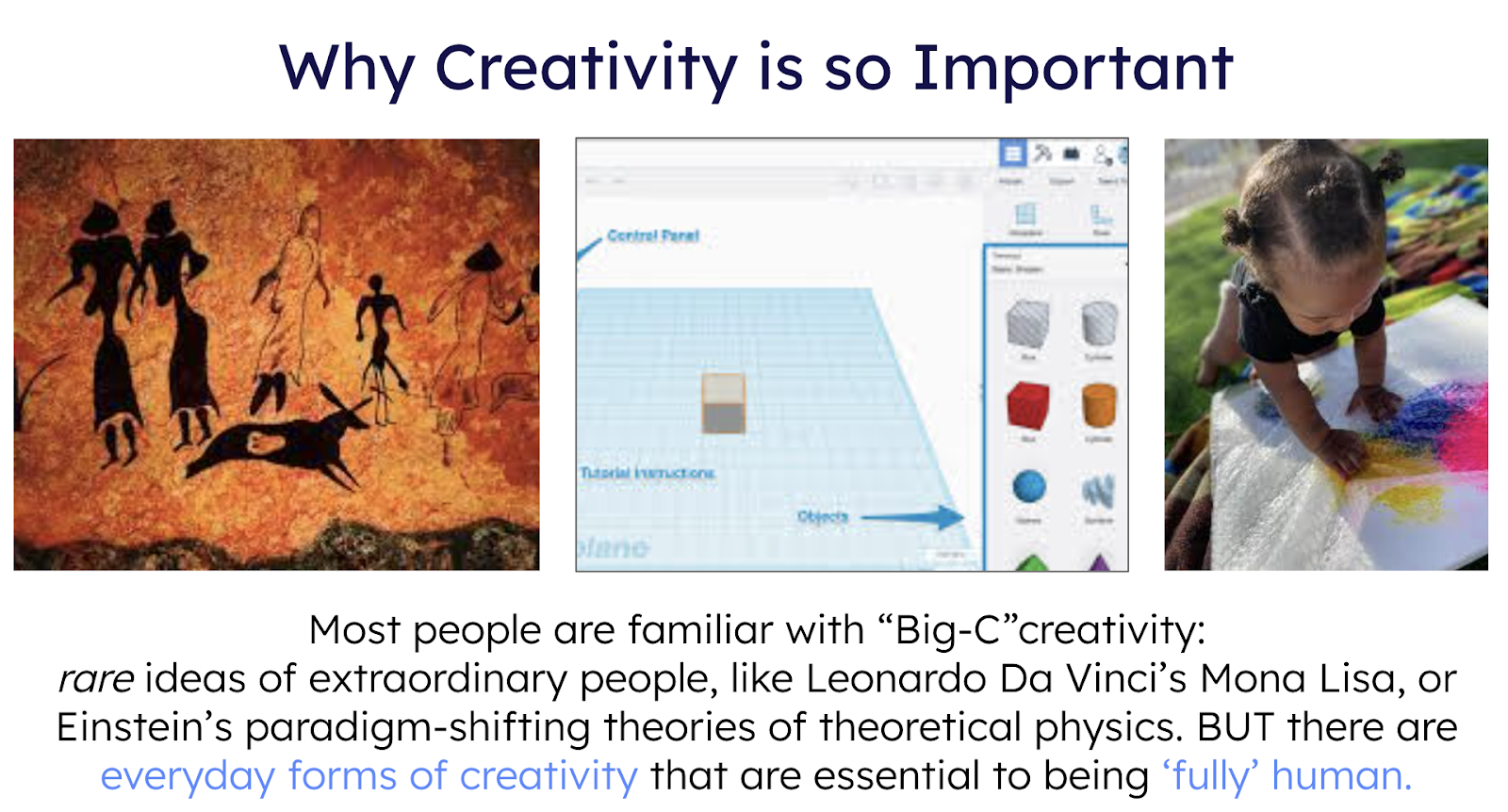
Manaiakalani Maths Intensive Day 9 - Create and Share

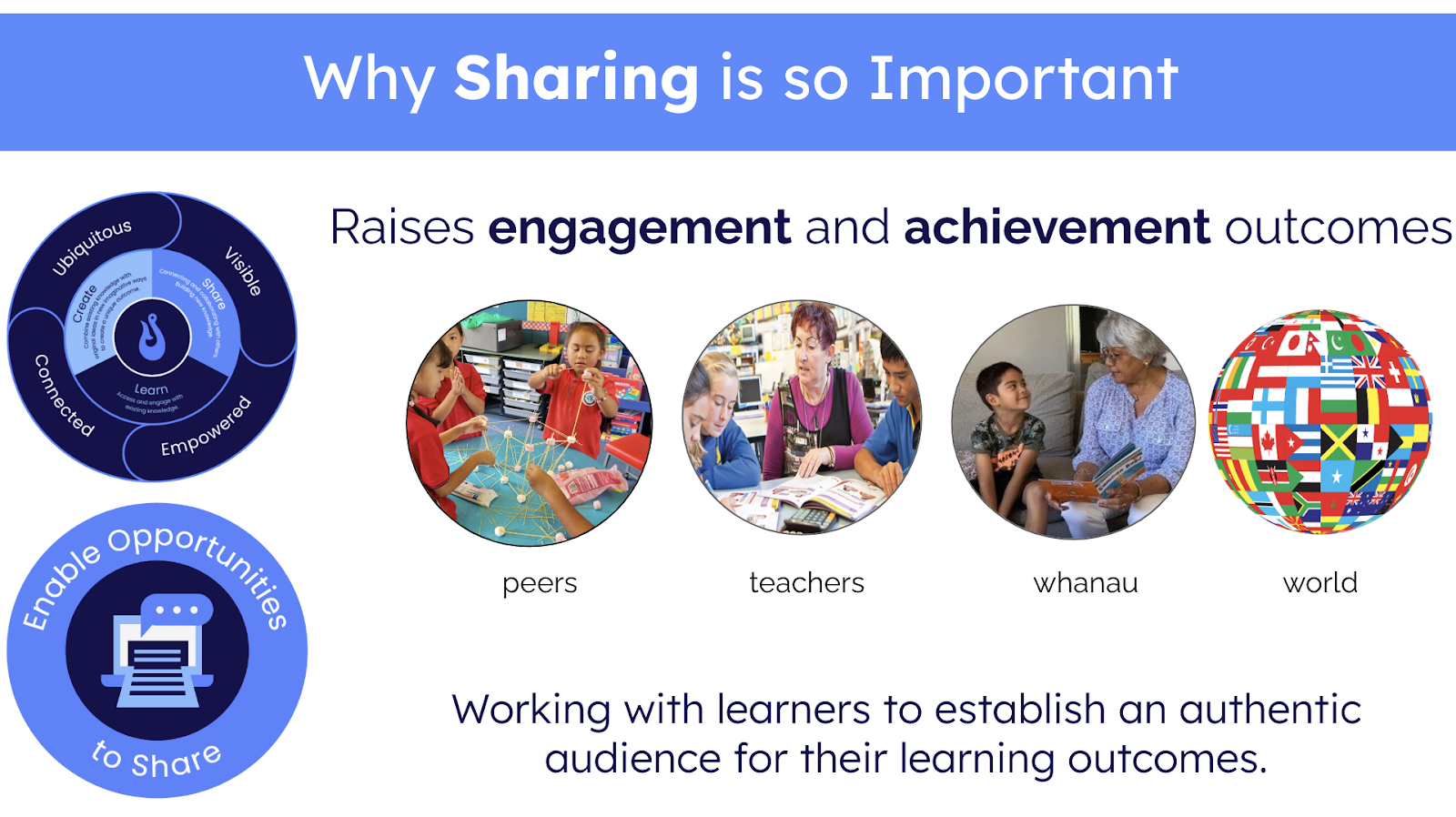
Today marked the final day of the Manaiakalani Maths Intensive, with a focus on two key ideas: Creating and Sharing. 

Creating in Maths

I’ve always found creating in maths more challenging to implement than in literacy. This is due to a number of reason however the main one is getting too focussed on the learning aspect of maths. There is a myriad of new concepts to learn which often takes priority, leaving little room for create tasks.

However, today reminded me how valuable create tasks can be in deepening students' understanding and engagement with maths. The act of creating allows students to connect their learning in meaningful ways, whether through visual models, digital presentations, or collaborative projects. It’s not just an “extra” but a powerful way to consolidate their learning.

The key, I’ve realised, lies in planning ahead. It’s about being intentional in setting aside time for these creative tasks, ensuring they are not rushed or overshadowed by the pressure to move on to the next topic.


Tools for Creativity
Over the nine sessions, Dorothy Burt has introduced an incredible range of tools that open up possibilities for creativity in maths. From dynamic apps to interactive platforms, these tools encourage students to not only engage with concepts but to share their understanding in innovative ways.

Looking Ahead
One of my goals during the upcoming break is to dive deeper into these tools, exploring their potential and planning how to incorporate them into my teaching in 2025. I want to build a toolkit that balances foundational skills with opportunities for students to think creatively and express their ideas.


Thursday, 7 November 2024

Manaiakalani Maths Intensive Day 8 - Statistics and Probability

Today's MPI session was all about Statistics and Probability. Below are my thoughts/takeaways.

Data Talks

One takeaway was the idea of data talks. Data talks are all about presenting students with a graph, chart, or dataset, then letting them take the lead in analysing what they see. The aim is to prompt students to make their own observations, ask questions, and spark a discussion based on their interpretations of the data.

I love that this approach turns math into a more interactive and student-driven experience. Instead of me explaining what’s going on, I get to see students actively involved, pointing out trends, forming hypotheses, and discussing ideas with their peers. Data talks can be adapted to so many different topics too. I can picture using them in lessons covering everything from sports statistics to environmental data, or even something fun like snack preferences in the class.

Investigative Questions

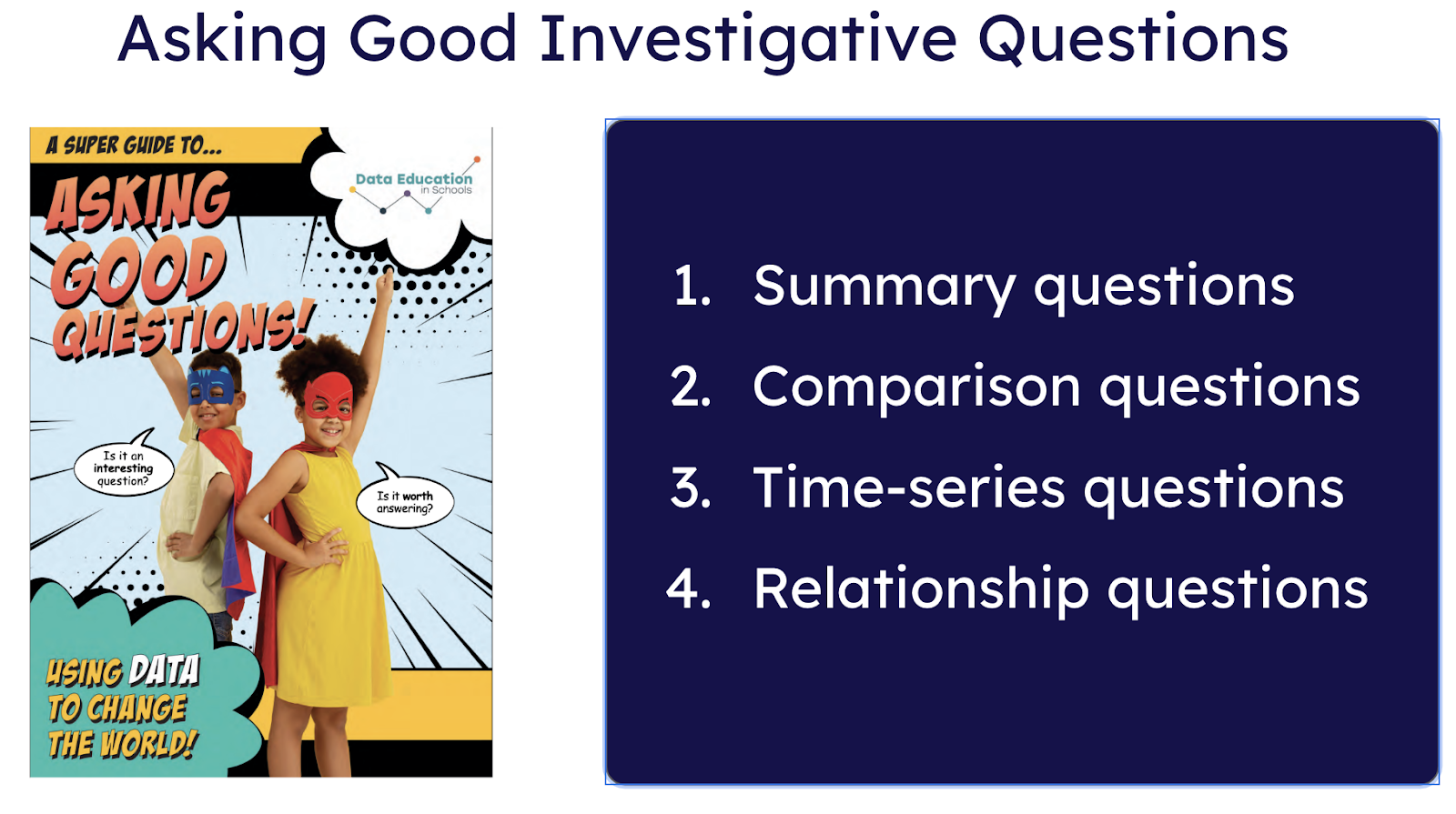
I was also interested in hearing about the different types of investigative questions and how they align with the various NZC maths phases:

Summary Questions – These focus on a single dataset to highlight the main features. Example: “What’s the average number of books read by our class this year?” They help students grasp the general behaviour of a group.

Comparison Questions – These involve comparing multiple datasets. For instance, “Do boys and girls in our class spend the same time on homework?” They encourage students to think critically about similarities and differences.

Time-Series Questions – These track changes over time, such as “How have temperatures changed monthly this year?” They help students identify trends and make predictions.

Relationship Questions – These explore links between variables. Example: “Is there a relationship between study time and test scores?” They prompt students to consider cause, effect, and correlation.

I had never had this shown to me before. Knowing this will help me guide my future lessons and discussion around data with my students. 


This has given me some great things to think about and I look forward to sharing them with my team.


Thursday, 17 October 2024

Manaiakalani Maths practise Intensive - Day 7 - Geometry

Today's session was all about geometry.

One thing that really stood out to me is how vocabulary-intensive geometry is. It involves a lot of subject-specific terms like vertices, supplementary angles, complementary angles, vertical, parallel, adjacent, tessellation, transformation, and more. Each term is not just a label but a concept that students need to internalise and apply correctly. This poses a significant challenge for students, especially when they encounter so many new words in such a short period. I’m left wondering how to help them grasp all of these terms effectively and, more importantly, retain them beyond the current unit. I believe this requires regularly incorporating this vocabulary throughout the entire school year, not just during the geometry unit. By normalising the use of these terms in the classroom—whether we're discussing shapes, angles, or even patterns in other contexts—I suspect they will become a natural part of my students' vocabulary. The goal is to get to a point where these words aren’t intimidating or foreign, but rather part of their everyday language when discussing mathematical concepts.

Another thing that really stood out to me was the number of incredible digital tools available to make teaching geometry easier and more engaging. One tool I’m especially excited to try with my students is Amplify Polypad. It’s packed with interactive features like virtual manipulatives, grids, and geometry tools that help students not only visualise but also experiment with different concepts. This kind of hands-on exploration can be so beneficial, especially in a subject as visual as geometry. For instance, students can manipulate shapes, explore transformations, or work with tessellations directly on their screens, making abstract ideas more tangible. I think using something like Polypad will transform the way students engage with geometry, turning it into something dynamic and interactive, rather than just working through problems on paper. I’m hopeful that tools like this will help demystify some of the more complex concepts and lead to deeper understanding and excitement about geometry.

I hoping by incorporating these tools along with a focus on language will help make geometry more accessible and enjoyable for  my students. 


Thursday, 19 September 2024

Manaiakalani Maths practise Intensive - Day 6


Today's session was abut multiplicative thinking, fractions and decimals and measurement.

I was particularly interested in using visual representatives and materials to teach multiplying fractions. Historically, I have taught a rule for solving fraction multiplication such as 1/2 x 1/3 however, as was pointed out to us, only teaching the rule does not enable the kids to develop a conceptual understanding of what actually happens to the fraction when multiplying them. Much like teaching algorithms for whole number multiplication, children could complete the steps but didn't understand why it worked. In the coming weeks I'll be endeavouring to use materials and visual representatives to teach the multiplication of fractions in the hopes my children will develop their conceptual understanding of it. 


I am also interested in using Polypad  Blockout game as a digital tool to help my children develop their understanding of arrays and multiplication skills. It was great to see something that was easy to use and didn't require a login. I'm sure my kids will really enjoy this game.


Thursday, 29 August 2024

Manaiakalani Maths practise Intensive - Day 5

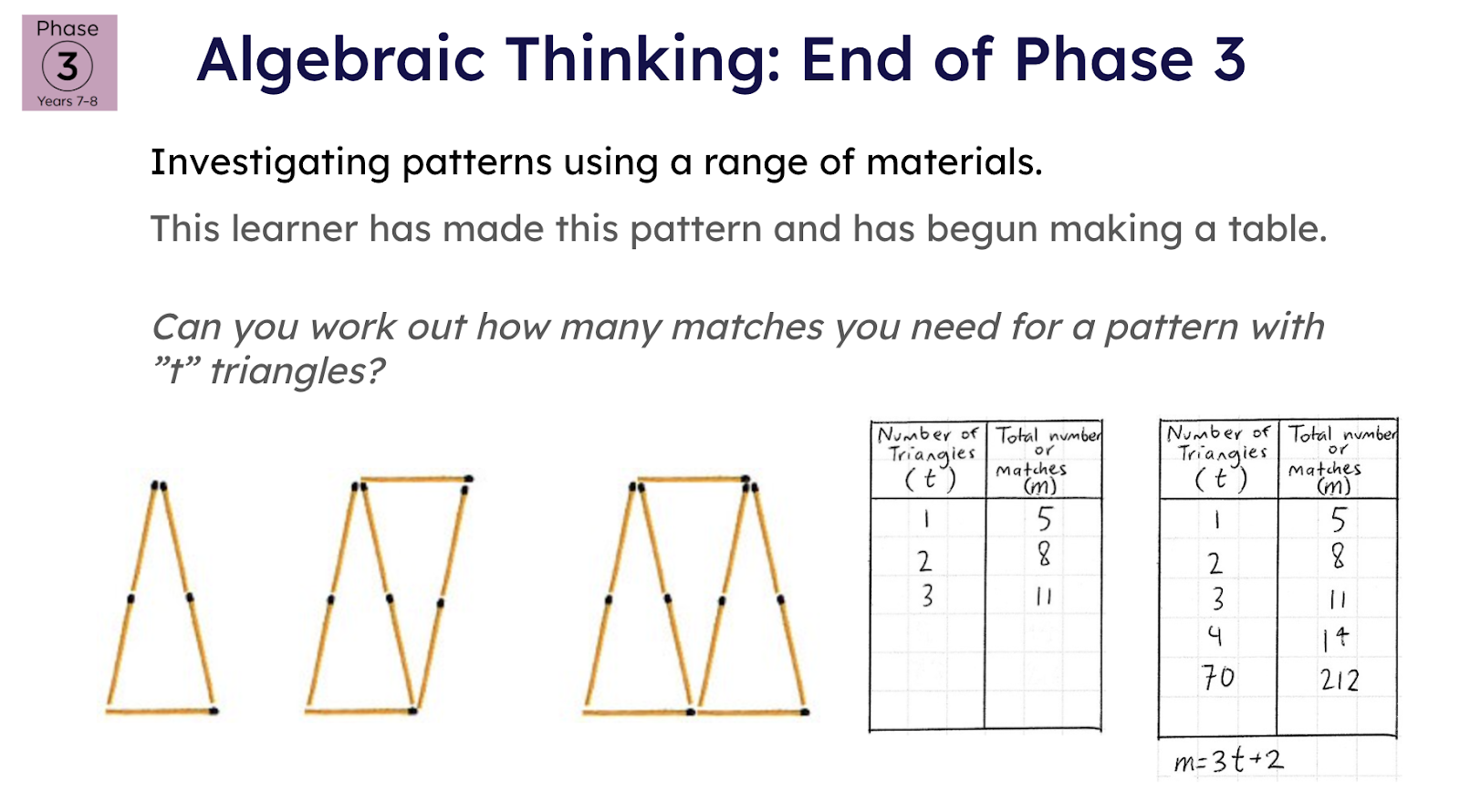
Today focus on the MPI was Algebra.


Vocabulary

I was reminded of the vast amount of vocabulary students need to comprehend in order to understand algebraic thinking and reasoning. 


This has got me wondering how I can go about ensuring my students are being exposed to this vocabulary regularly. A good example of this is number properties as listed below. While my students have experienced these properties they would not be familiar with the names of the properties. I will be endeavouring to teach vocabulary more explicitly with my students. 


Equations, Patterns and Relationships

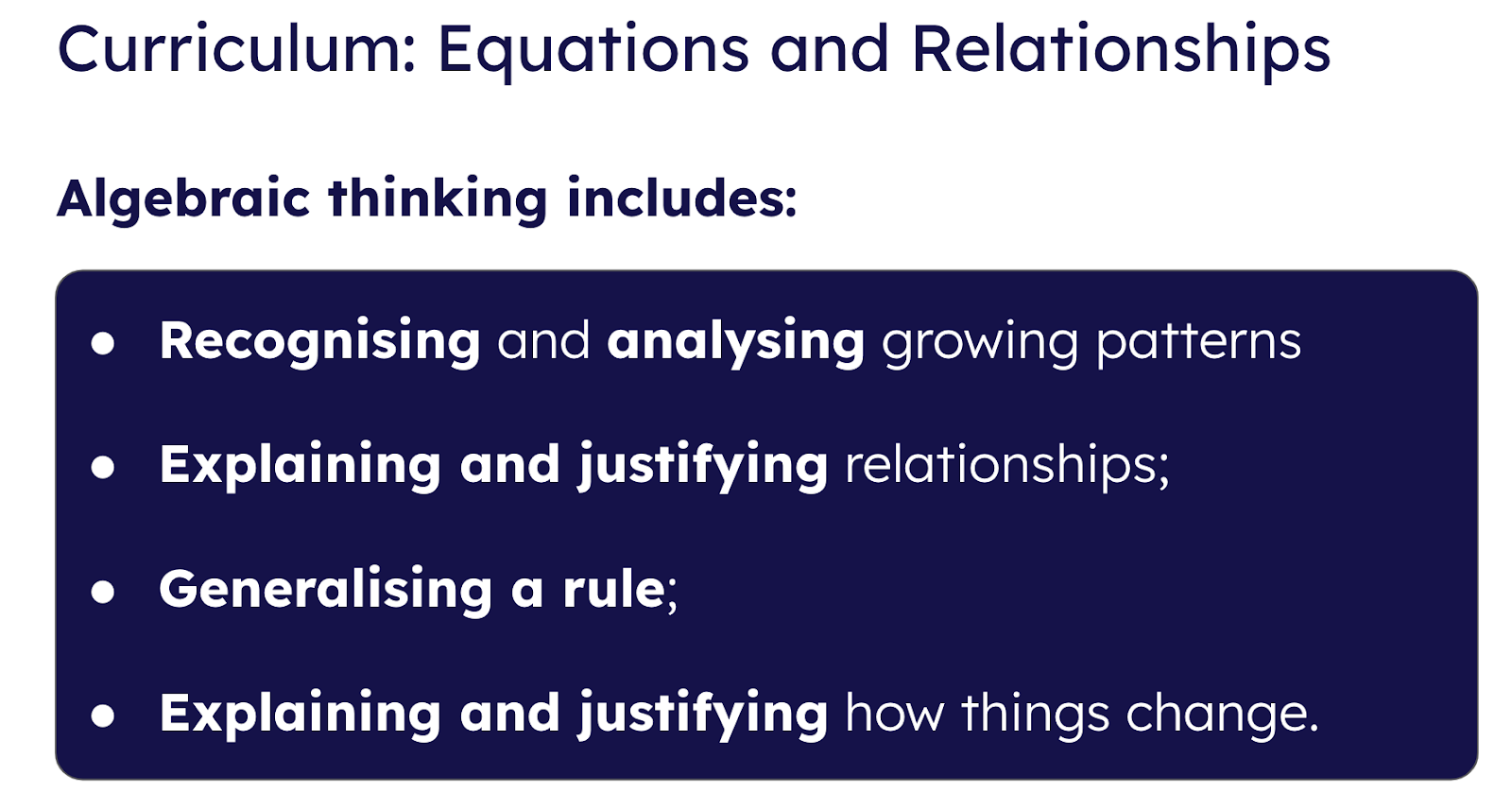
I was also reminded about giving my students multiple opportunities in a variety of contexcts to recognise and analyse patterns and relationships. Progressing from recognising and predicting patterns to generalising and identifying rules. I got some interesting new ideas to try with my students that I suspect both them and I will find engaging.


Thursday, 8 August 2024

Manaiakalani Maths practise Intensive - Day 4

Today we spent the day exploring number - Place Value, Fractions, Decimals, Percentages and Integers. Below are some of my takeaways. 

Materials/Manipulatives

I was reminded again how important it is to use materials to introduce new maths concepts, to further student's understanding and to correct misconceptions. In the coming weeks I'm looking forward to using deci-pipes and deci-mats to teach decimals. 


Vocabulary
I was also reminded how important maths vocabulary is in students mathematical understanding. I have come away thinking about how I can be more intentional and explicit about tending to this vocabulary. I have been guilty of focussing so much on teaching a new mathematical concept that I can brush over the vocabulary instead of taking the time to tend to it. 


Choral Counting
Choral counting is an activity in which the teacher leads children in counting aloud together by a given number. Today was the first time I was introduced to it. I can see how beneficial it could be for developing student's number sense and computational skills. I'm interested in using it particularly with decimals numbers for my year 7/8 students. 


Thursday, 25 July 2024

Teaching inquiry update


 Inquiry Focus Question

How can I enhance the enjoyment levels of reading for my students and what effect will this have? 

Towards the end of Term 2 I gave my literacy class a reading challenge. The purpose of the reading challenge was two fold.

1 - To increase my students reading "muscle"

2 - To encourage my students to read for enjoyment

The reading challenge involves students selecting a text of their choice based on 15 genres (historical fiction, humour, poetry etc). As students finish reading each text they complete a quick create task, again of their choosing. As students read a range of genres and texts of their choosing I hope this will develop their reading muscle (ability to read texts more consistently) and their enjoyment of reading.  Time will tell.


Thursday, 27 June 2024

Manaiakalani Maths practise Intensive - Day 3


Today was the third day of the Manaiakalani Maths Practice Intensive (MPI), focusing on planning an effective math program. Here are some reflections on the content I found particularly interesting.

Weekly Timetable

I was particularly interested in the discussion about structuring a weekly timetable for a class. In the past, I have used a tumble/rotation system, but it has always been challenging for students to complete their tasks or follow-up activities due to insufficient time.

Georgie introduced a new approach today: a tumble system where, aside from the time spent with the teacher, students have the freedom to choose what they do during the other slots. This method fosters student agency and allows them to take control of their learning.

I am eager to explore this approach. While I anticipate it will require significant scaffolding initially, I believe it will be beneficial in the long run.

Tracking my kid's progress

Another area I’m interested in improving is tracking my students' progress against the curriculum. Although I have the maths progressions as a starting point, I would like a spreadsheet with a more granular breakdown of achievement progression, such as knows times tables from 1-10. This detailed tracking would be extremely helpful in monitoring progress. I am hopeful that once the new curriculum is finalised, such detailed progressions will be included.


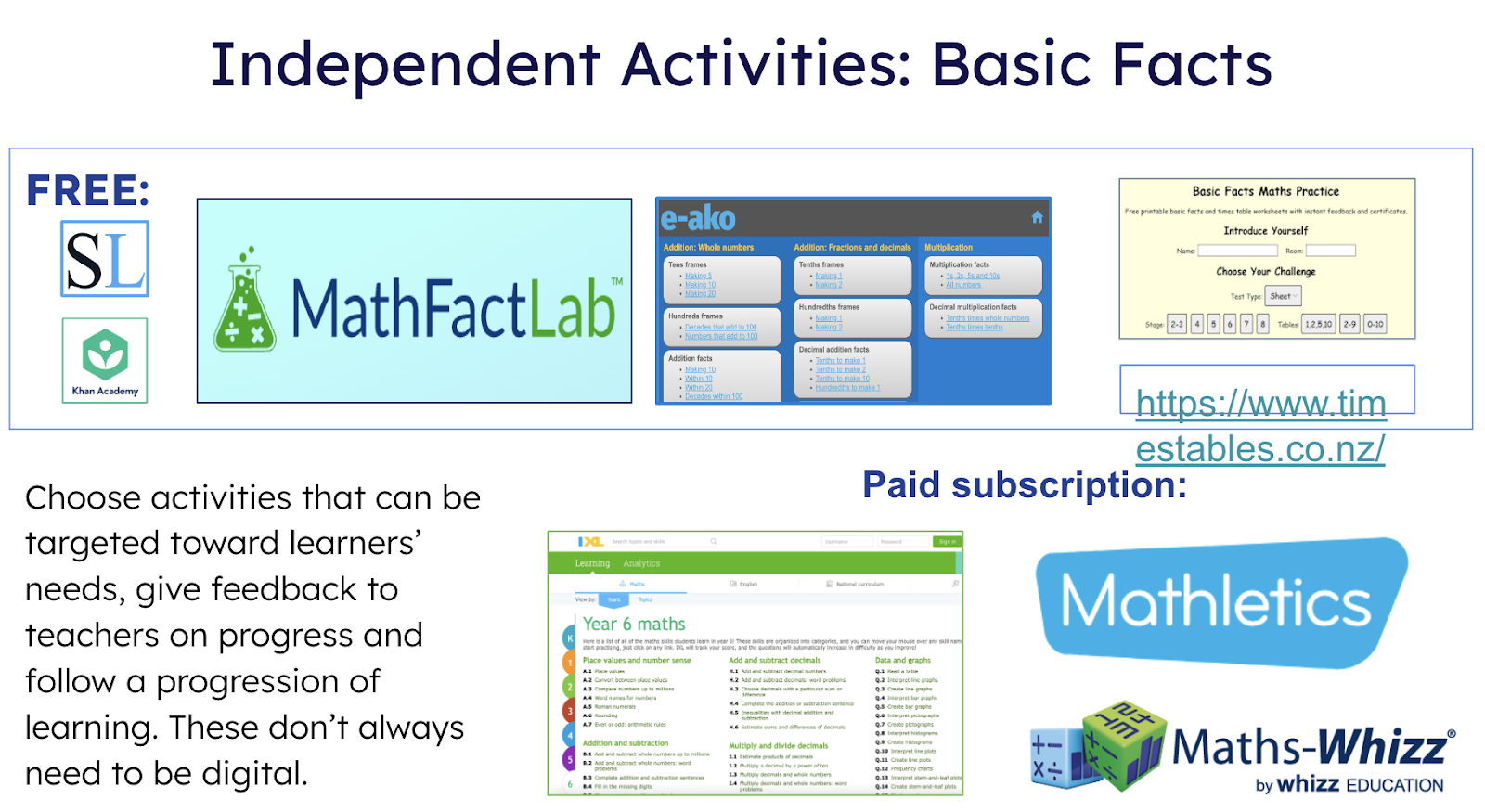
Independent activities

We had an opportunity to explore independent learning activities for children to do when they are not with me. I'm looking forward to trying out some of the activities listed below. My hope is to find something fresh and engaging that will be beneficial for my kids. While I already use independent activities, they could use some refreshing. The challenge I see is finding the time to track my children's progress on these independent activities.


Thursday, 6 June 2024

Manaiakalani Maths practise Intensive - Day 2

Teacher Workbook

Day 2 of the MPI brought a great bunch of things to think about and work on. I was particularly interested in the Teacher workbook that was highlighted. Essentially this is a one-stop shop spreadsheet that contains all the information you would need to plan and track your teaching and leanring. Some of the big pieces included:

  • Student assessment data
  • Responses to student maths profile survey
  • Long Term Planning Coverage
  • Weekly planning sheet
  • Curriculum leanring intentions for the various year groups


When I initially saw the workbook it was easy to get overwhelmed by all the tabs and the amount of possible information it could hold. However, I can see how it could be very useful in planning and tracking leanring and I'm looking forward to putting it to use. I like the idea of having everything in one place to plan and track for leanring rather than multiple spreadsheets, documents and sites etc.


Student Task board

I was also interested in the suggested student tasks boards. Like the planning doc, it was initially quite overwhelming with a load of content but I can see how if it was dialled back a bit it could be very helpful for our learners. I'm particularly interested in including more student choice into my practise.


Wednesday, 5 June 2024

Maths Student Survey Responses

I recently gave my maths class a survey about how they view themselves as mathematicians. The results were interesting. Below I have shared some reflections from the data. There was a total of 28 responses from individual students.


How do you feel about maths?

1) I hate maths  -  4) I love maths 


43% either hated or disliked maths. I would like to dig deeper and find out why these children feel this way. My hope is that by the end of the year we will have a more positive result to this question.


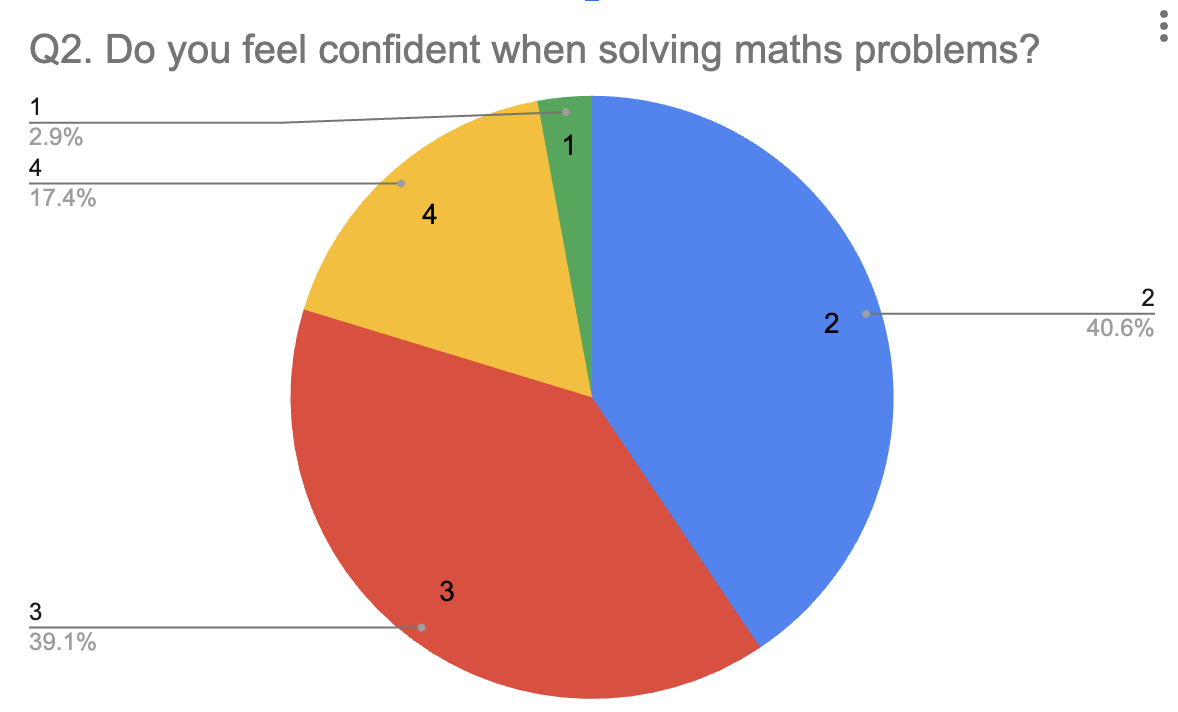
Do you feel confident when solving maths problems?

1) I'm not confident at all  -  4) I feel very confident


Does your teacher think you are good at maths?

1) No the think I struggle  -  4) Yes they think I'm really good 

I was initially surprised by this response because I thought more of them would have picked 3 or 4. Upon reflection I wonder if a better question could have been 'Does your teacher believe you are capable of achieving in maths'. The reality is, some children do struggle with maths, they know it and the teacher knows it. It would be ignorant for a teacher to believe a child is good at maths when clearly they struggle however hopefully teachers are believing their children are capable of achieving despite them struggling.


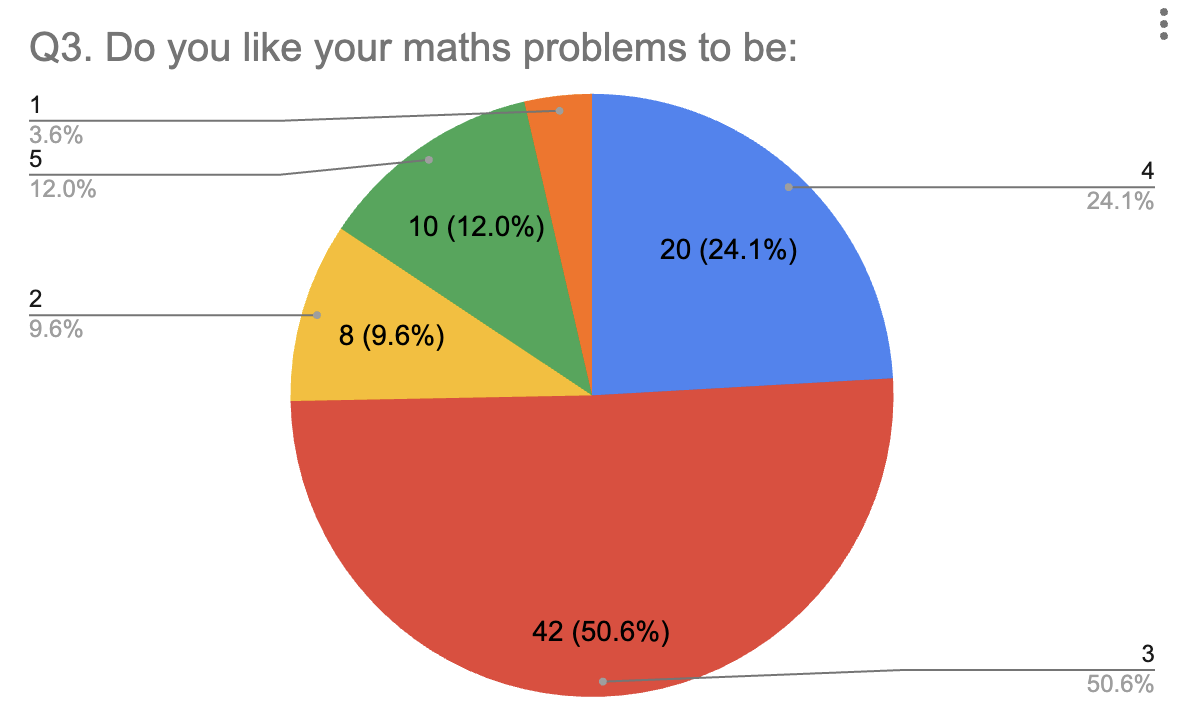
Do you like your maths problems to be:

1) Easy -   5)Hard

I found it interesting and reassuring that 36% wanted reasonably hard or hard problems. I assumed it would have been less. I suspect the 50% that selected 3 want problems that aren't to hard or too easy but somewhere in the middle like the Goldilocks Zone.


Overall, these survey results gave me some great things to think about. They have actually given me more questions than answers however that is a good thing and I'm looking forward to finding out more. 


Thursday, 16 May 2024

Manaiakalani Maths practise Intensive - Day 1

Today was the first day of the Manaiakalani Maths practise Intensive (MPI), a 9 day maths development course aimed at equipping teachers with the necessary skills and knowledge to teach maths effectively. 

For part of the day we reflected on the Pillars of Mathematics Practise. We asked ourselves what elements are we doing well in and what elements need attention. I found this a productive and worthwhile exercise. In the business of teaching you often don't have the time to do this, or if you do it gets taken up with something more pressing.


From this reflection I came away wanting to focus on developing extended mathematics discussion in my practise. Years back I did a lot of this, particularly when our school was adopting the Developing Mathematical Inquiry Communities (DMIC) pedagogy. However, in recent years I haven't been using discussion based leanring in maths. I look forward to teaching my students about the Ground Rules for Talk and developing their ability to robustly discuss maths problems and to share and justify their thinking.  


I was also interested in how I could integrate other curriculum areas into maths. Because I see another group of students for literacy I have often shied away from integration in maths however, I see the benefits am looking forward to embracing the integration challenge. Stay tuned for more updates.


Saturday, 30 March 2024

Teaching as inquiry target group

Inquiry Focus Question

How can I enhance the enjoyment levels of reading for my students and what effect will this have? 

My target group for my teaching inquiry is made up of 6 year 7 & 8 children -  2 girls and 4 boys. 

Through the reading survey, all 6 children indicated they were not reading a book for enjoyment and they do not enjoy reading. 

NAMEYEARGENDERREADING AGE
JF8Boy14
NG8Girl13.5
NM7Boy13
JF7Boy12
TR8Boy12
OV7Girl12


Tuesday, 5 March 2024

Manaiakalani Class OnAir 2024


This year, I am one of the Manaiakalani Class OnAir teachers. My focus is to demonstrate and showcase content form the Manaiakalani Reading Practise Intensive (RPI) I participated in last year. The RPI is a reading professional development course that seeks to equip teachers with the necessary skills to effectuively tecah reading in the 21st century. You can read more about this by reading my posts from last year. 

My first Class OnAir episode is complete. A full lesson plan, video and reflection can be found here.


Teaching Inquiry Update

At the midpoint of my inquiry, I have started to see positive shifts in how students communicate their thinking during learning tasks. My i...